
Cretaceous Dinosaur Tracks · Umajalanta Cave (Bolivia’s Deepest) · Andean Condor · Red-fronted Macaw · El Vergel Waterfalls · Ancient Rock Paintings · Private 4WD
Overview
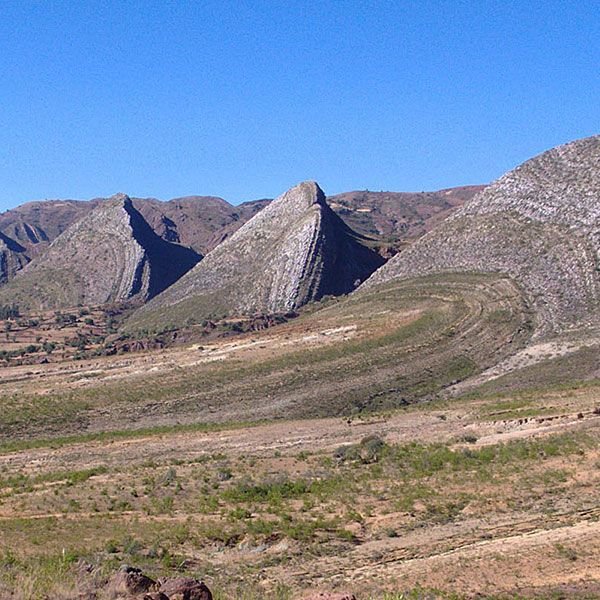
Toro Toro National Park is one of the most spectacular and underrated destinations in Bolivia — a high-altitude limestone plateau in the southern Cochabamba department where the forces of geological time have created a landscape unlike anywhere else in South America. Over millions of years, tropical rivers eroded the Cretaceous limestone into a system of deep canyons, cave networks, and sculpted rock formations, while preserving in the exposed bedrock the footprints of dinosaurs that walked here 68–80 million years ago.
Although it is not currently listed as an official UNESCO Global Geopark, the region has been promoted as the Torotoro Andean Geopark because of its outstanding geological heritage: dinosaur tracks, cave systems, fossil-rich landscapes and unusual rock formations that rival any natural wonder in South America.
Our private Toro Toro National Park tour is designed for travelers who want more than a standard sightseeing trip. Over three days, we explore the highlights of the park with private transport, local guides and a flexible itinerary that combines adventure, geology, wildlife, photography and culture.
Largest concentration of Cretaceous tracks in Bolivia — theropod, sauropod & ankylosaur footprints
Bolivia's deepest cave — stalactites, stalagmites & an underground lake with blind cavefish
Ciudad Itas is one of Bolivia's most reliable sites for close condor observation on morning thermals
Critically range-restricted, Endangered parrot found only in a small area of the Bolivian Andes
Why visit
Toro Toro National Park is one of the most spectacular and underrated destinations in Bolivia — a high-altitude limestone plateau in the southern Cochabamba department where the forces of geological time have created a landscape unlike anywhere else in South America. Over millions of years, tropical rivers eroded the Cretaceous limestone into a system of deep canyons, cave networks, and sculpted rock formations, while preserving in the exposed bedrock the footprints of dinosaurs that walked here 68–80 million years ago.
Although it is not currently listed as an official UNESCO Global Geopark, the region has been promoted as the Torotoro Andean Geopark because of its outstanding geological heritage: dinosaur tracks, cave systems, fossil-rich landscapes and unusual rock formations that rival any natural wonder in South America.
Our private Toro Toro National Park tour is designed for travelers who want more than a standard sightseeing trip. Over three days, we explore the highlights of the park with private transport, local guides and a flexible itinerary that combines adventure, geology, wildlife, photography and culture.
This tour is ideal for hikers, photographers, families, birdwatchers, nature lovers and anyone looking for one of the true highlights of the Cochabamba region.
Tour highlights
Dinosaur footprints and fossil-rich limestone landscapes
Umajalanta Cave — Bolivia's most famous cave system
Ciudad de Itas rock formations and high-altitude scenery
Toro Toro Canyon and El Vergel waterfall (swimming included)
Andean condors soaring above the canyon rim
Red-fronted macaw — a rare Bolivian endemic
Viscachas — one of Bolivia's most photogenic Andean mammals
Ancient pictographs and petroglyphs (2,000+ years old)
Colonial stop at Tarata village (17th-century church)
price includes
price excludes
We begin with hotel pick-up in Cochabamba and travel by private 4WD toward Toro Toro National Park. The journey normally takes around four hours in the dry season, although travel time can be longer during the rainy season — the drive itself is part of the experience, passing through valleys, rivers, traditional communities, agricultural landscapes and impressive rock formations.
En route, we stop at Tarata — a beautifully preserved colonial village approximately 30km from Cochabamba with a 17th-century church and traditional market — a pleasant cultural introduction before the road climbs into the limestone plateau country.
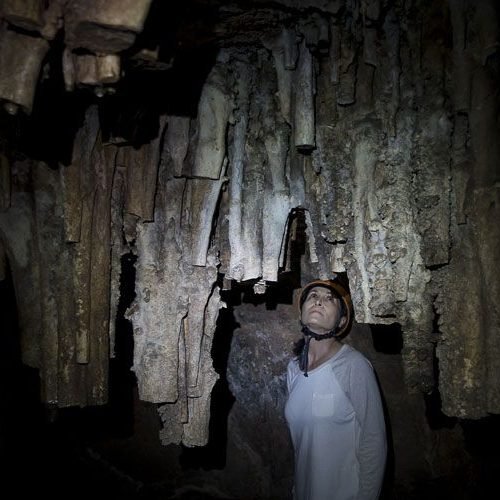
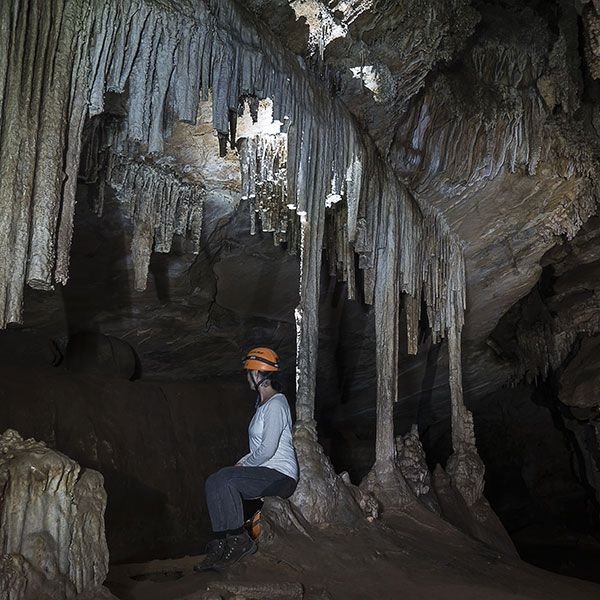
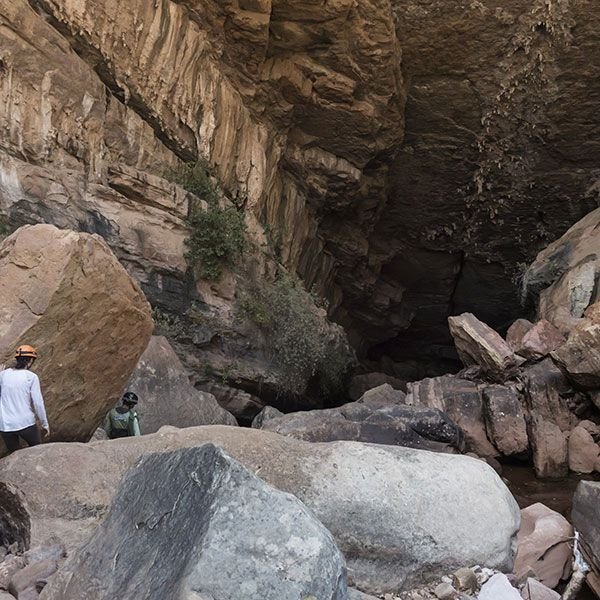
On arrival, park fees are paid and the group checks in to the hotel. After lunch, the afternoon is devoted to Umajalanta Cave — Bolivia’s deepest cave, a remarkable natural cathedral of limestone formations. Helmets and headlamps are provided. The descent passes through chambers of stalactites, stalagmites, and calcite formations to an underground lake where blind cavefish (Trichomycterus sp.) inhabit the dark water — animals that have lost their eyesight through thousands of generations of cave adaptation.
Around the cave area, we keep an eye out for viscachas — large, rabbit-like Andean rodents commonly seen among the rocky slopes and one of the most photogenic mammals in the Bolivian highlands.
After breakfast, the 4WD departs for Ciudad Itas — a spectacular landscape of eroded limestone formations at over 4,000m elevation. This area is known for its giant rock towers, natural windows, caves, narrow passages and surreal stone scenery shaped by wind and water over millennia. It is also the best Condor-watching location in the park: Andean Condors with 3-metre wingspans are resident here and are reliably observed catching thermals above the formations during morning hours.
We also look for the endemic red-fronted macaw, a highly threatened Bolivian bird found only in a limited range of dry inter-Andean valleys — Toro Toro is one of the best places in the world to search for this rare species.
The afternoon explores a series of rock panels bearing ancient pictographs and petroglyphs estimated at over 2,000 years old, attributed to pre-Inca cultures that inhabited the canyon zones. These paintings — mostly geometric, zoomorphic, and anthropomorphic symbols in red ochre — are remarkably well-preserved in sheltered limestone overhangs.
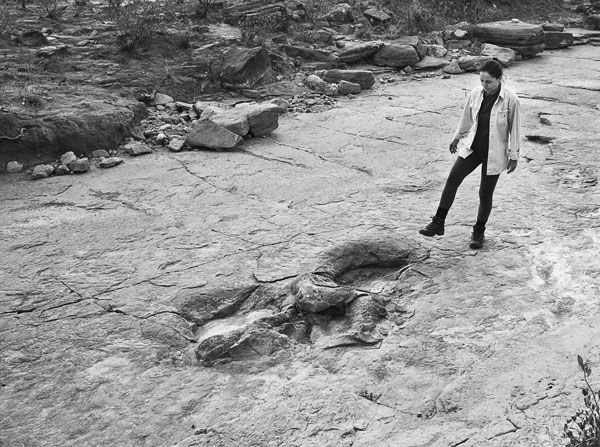
The day continues with visits to multiple confirmed Cretaceous dinosaur trackways: large flat limestone surfaces where theropod (bipedal carnivore) and sauropod (large quadruped) footprints are preserved in the former lakebed sediments of 68–80 million years ago.
The final morning begins at Toro Toro’s natural amphitheatre — a dramatically eroded limestone bowl where some of the park’s largest and most photogenic dinosaur trackways are found. From here, the route leads to a canyon viewpoint that is the primary flight corridor of the Red-fronted Macaw (Ara rubrogenys) — an Endangered species found nowhere on Earth outside this narrow Bolivian canyon system. Your guide scans the cliff faces and canyon walls for nesting pairs and foraging flocks.
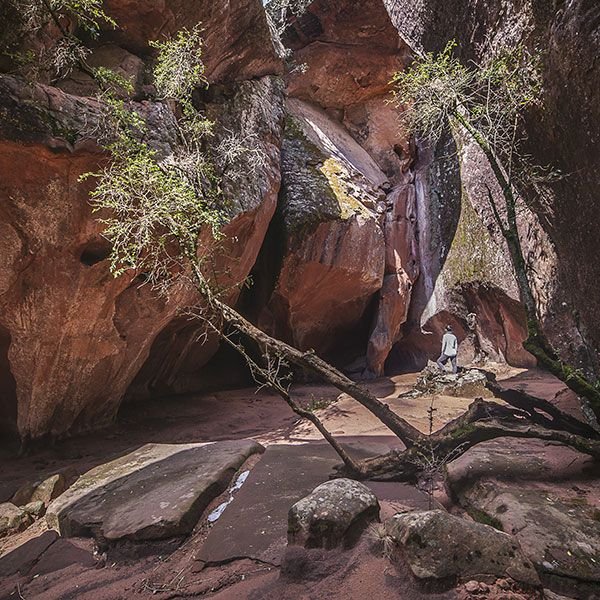
We then descend approximately 1,000 stone steps into the main canyon to reach El Vergel — a series of waterfalls dropping into pristine natural pools enclosed by towering limestone canyon walls draped with subtropical vegetation. Swimming in the pools is included when conditions allow.
After the climb back out and one final stop at additional dinosaur trackways, we return by private 4WD to Cochabamba, arriving at your hotel approximately 19:00–20:00.
End of services.
Wildlife
Toro Toro is best known for geology and dinosaur footprints, but it is also a rewarding wildlife destination. The park and surrounding valleys provide habitat for some of Bolivia’s most iconic species — all observed in completely wild and natural conditions.
The Red-fronted Macaw
The Red-fronted Macaw (Ara rubrogenys) is one of Bolivia’s most iconic and threatened birds — a colourful macaw endemic to the country that survives only in a restricted area of dry inter-Andean valleys. Toro Toro National Park is one of the best places in the world to search for this rare species.
Sightings are never guaranteed, but your guide knows the specific canyon viewpoints and flight corridors where flocks are most often observed. When conditions are right, watching a flock of Red-fronted Macaws streak through the canyon is one of the most memorable wildlife experiences Bolivia has to offer.
Wildlife sightings — including Red-fronted Macaws, Andean Condors and viscachas — are never guaranteed. Our guides will do their best to find wildlife, but all animals are observed in their natural habitat.
Family travel
Yes — Toro Toro can be an excellent family tour, especially for children and teenagers interested in dinosaurs, caves, fossils, waterfalls and adventure. Some hikes and the cave excursion require care, so the itinerary can be adjusted depending on age, fitness level and comfort with enclosed spaces.
For families who want a softer version of the tour, we can focus more on viewpoints, dinosaur tracks, short walks, local culture and scenic landscapes. The pace and difficulty level are always adjusted to the group.
Dinosaur tracks, fossils and caves make this one of Bolivia's most engaging destinations for younger travelers.
We adapt hikes and activities to the group's fitness level. The cave can be skipped if not suitable.
Natural pools at the base of El Vergel waterfall offer a highlight moment for all ages.
Our team replies within a few hours. We also speak Spanish and English.